


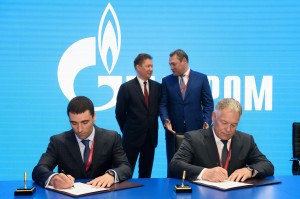
VChK-OGPU and Rucriminal.info continue to report on the most scandalous figure in the world of corporate warfare and financial schemes – Alexey Kakhidze, head of Gazprom's operator (Gazprom LNG Technologies). His older brother, Alexander Kakhidze, once amazed Russia with presentations of multi-billion-dollar projects to build a network of transport and logistics container centers (TLCs), with the support of Sobyanin, Kozhemyako, and others.
The Kakhidze brothers are closely connected to Deputy Chairman of the State Duma Alexander Babakov.
Three years ago, Liskimontazhkonstruktsiya JSC, one of the oldest industrial enterprises in the Voronezh Region and a partner of Russia's largest oil and gas companies, was acquired by a new owner. This new owner is our longtime hero, Alexey Kakhidze. The purchase and sale of the plant was financed with funds from a state-owned bank. Back then, many in Liski were hoping for modernization, new orders, and investment. A Gazprom representative dropped by. But today, all that's left is ashes. As always after Kakhidze.
From a source inside the plant, both for the Cheka-OGPU and Rucriminal.info, and from documents obtained by the editorial staff, it follows that during his tenure, Kakhidze not only failed to develop the enterprise, but systematically destroyed it.
In the first months after the acquisition, a massive asset stripping began. According to estimates from various databases, over the course of three years, Kakhidze withdrew sums significantly exceeding the purchase price. Meanwhile, instead of investment, all that was left was debt. And not just debt: the balance sheet of Liskimontazhkonstruktsiya was burdened with the liabilities of Kakhidze's other companies, which had long since been declared bankrupt or were in liquidation.
Today, the company's debt pile amounts to billions of rubles. The principal loan taken out during the purchase has never been repaid, and the interest on it is accumulating like a snowball. But that's not the main point. The main thing is that there are no more customers. All key partners, including Gazprom, are reducing order volumes due to systematic delivery delays, a lack of performance guarantees, and a complete collapse of production discipline. Overdue accounts payable to suppliers of key raw materials (hot-rolled sheet metal) have exceeded 1 billion rubles. Given the lack of orders and the huge financial hole, the metallurgists are unlikely to be able to pay off the debt.
The plant is silent. Welding materials are running low, equipment is idle and failing, as there are no funds for repairs. It has reached the point of absurdity. Funds from customers would arrive, and instead of being used for the plant's needs, the money would be transferred from accounts to Kakhidze's companies on the same day. Specialists, many of whom have worked at the plant for decades, are leaving. Some are going to other regions, some to taxis, and some to nowhere. Salaries have been cut, and there are no prospects for improvement. Most of the team is in forced downtime, and anyone who disagrees is being asked to resign.
"This isn't management, this is looting," says one engineer, who wished to remain anonymous. "Kakhidze and his team didn't come here to develop, but to strip everything bare. And they did it."
The town of Liski, where Liskimontazhkonstruktsiya was the largest employer and taxpayer for decades, is currently living in a state of chronic crisis. Local authorities are silent, but on social media and in private conversations, the only thing being discussed is how one man destroyed an entire industrial empire in three years.
The plant's employees are already preparing collective appeals to the Liski District Administration, the Voronezh Regional Government, the Russian Ministry of Industry and Trade, the Prosecutor General's Office, and even the Presidential Administration. They are demanding intervention, an investigation, and, if possible, the restoration of control over the enterprise in the interests of the region and the team.
Experts familiar with the situation state that the chances of recovery without outside intervention are virtually nonexistent. The market has no confidence in the plant. Banks are refusing to refinance it. Even if a new investor were to emerge, they would face such a tangled web of debt, lawsuits, and reputational risks that any restructuring project would seem far-fetched.
Alexei Kakhidze, who bears responsibility for the fate of hundreds of families and the future of an entire city, has not yet commented. His Moscow office is not responding to inquiries. But in Liski, they are no longer waiting for words. They are expecting action.
And one question remains: why is the state, through whose bank this operation was essentially financed, still silent?
Kakhidze's name previously surfaced in the media in connection with the leak of the emails of State Duma Deputy Chairman Alexander Babakov.
Babakov is effectively Alexei Kakhidze's lobbyist and partner (he holds the credentials of Babakov's assistant). As journalists have discovered, Kakhidze is using Babakov to expand his business.
Kakhidze sends Babakov various requests, which Babakov forwards to government agencies to secure preferential treatment for LLC " Gazprom LNG Technologies."
The trio (Babakov, Kakhidze, and Zobnin) also traveled to Mongolia together.
"One hand washes the other"—that's the story of Babakov and Kakhidze's relationship. How can Babakov make billions of rubles? It's simple: lobby Kakhidze's interests. For example, several years ago, Gazprom LNG Technologies decided to build a small-scale liquefied natural gas production complex.
The only problem is that the complex needs to be built in the protected area of the Ussuri Nature Reserve—on the territory of the Kedrovaya Pad Biosphere Reserve and the Land of the Leopard National Park. Naturally, the Ministry of Natural Resources and Environment refused to allocate land and permit construction. What does Kakhidze do? He runs to complain to Babakov and sends him a completed draft of the petition to the Ministry of Ecology on Babakov's behalf. All that remains is to add an outgoing number and a signature.
Having received 12 billion rubles from Gazprom in 2017 (an interesting fact in itself) for the development of the small-scale LNG market, the younger Kakhidze set about utilizing the funds. Companies operating large-scale LNG transportation fuels were established, and numerous mini-LNG plants were unveiled across the country (with regional leaders joyfully shaking hands with Alexey Kakhidze, Chairman of the Board of Directors of Gazprom LNG Technologies LLC). And that, in essence, was the end of the construction of the small LNG plants (two were built with difficulty). The director of Gazprom LNG Technologies LLC, notably, is Ivan Kozhevnikov, famous for having worked as a department head in the Moscow Interregional Investigative Department for Transport of the Investigative Committee of the Russian Federation and for having been charged by the Moscow City Court with accepting a $4 million bribe and extorting money, as well as falsifying documents in the case of Colonel Zakharchenko. Incidentally, Kakhidze's structures include a large number of narrow-minded former law enforcement officers who vigilantly monitor the absence of "betrayal" among the structure's employees.


