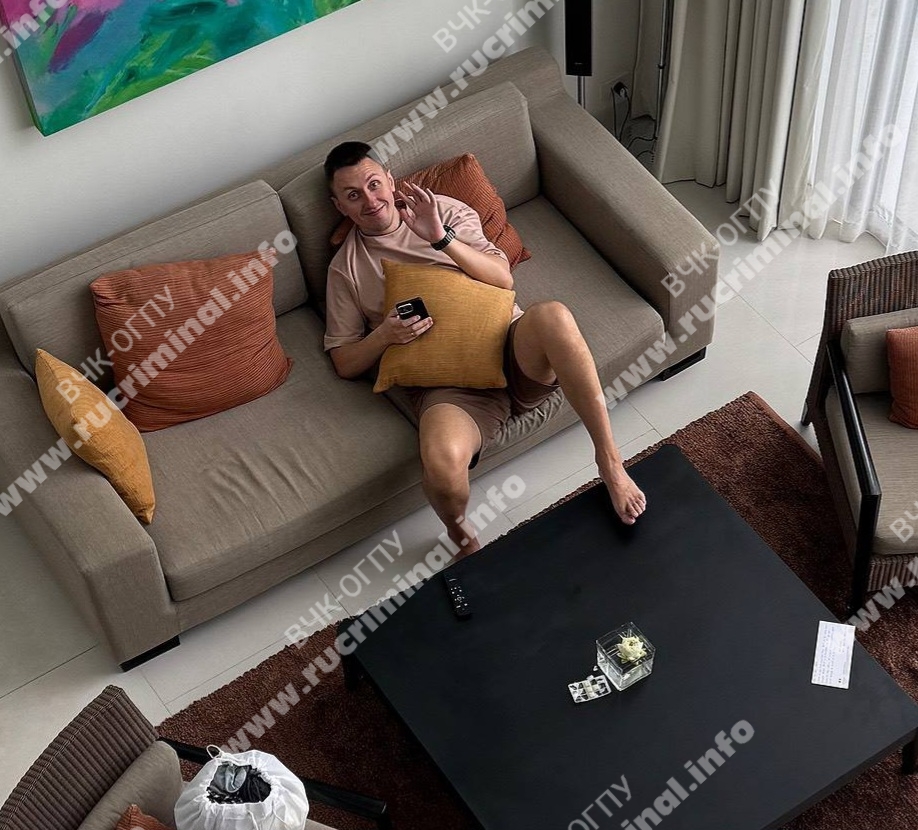
Moscow has decided to compete with the US for the right to obtain Kremlin hacker Denis Obrezko, who was detained in Thailand in November 2025. He is pictured exactly 24 hours before he was handcuffed at the request of the US. In Russia, the hacker was linked to Mikhail Dulin, a now former employee of the Presidential Administration (at one time responsible for attacks on Alexei Navalny's websites), who also fell into disgrace and is now hiding in the North Caucasus Military District. Russian security forces have long been unable to come up with any other solution other than to also place Obrezko on the international wanted list and compete with the US for the right to extradite him.

According to materials reviewed by the Cheka-OGPU and Rucriminl.info, on November 18, 2025, three days after Obrezko's arrest was announced, the Investigative Department of the Ministry of Internal Affairs of the Russian Federation charged him in absentia under Articles 210 (participation in a criminal organization), 272 (unauthorized access to computer information), and 158 (theft). To do this, they dusted off a criminal case that had been opened in 2018 in Kaluga against a group of local young people who had gained access to the customer database of a mobile operator, registered new SIM cards to the operator's customer accounts, and then transferred the funds in the accounts to their bank cards through an online payment service.
On November 18, 2025, Obrezko was placed on both a federal and international wanted list. On November 20, the Meshchansky Court ordered Obrezko's arrest in absentia. On December 10, following a formal appeal to the Moscow City Court, the decision entered into force and the materials on Obrezko were transferred to Interpol.
Thailand now faces two extradition requests for the hacker – one from the US and one from Russia. Russia's prospects are extremely slim.
Russia has used such hastily cobbled-together materials to obtain information on numerous hackers detained abroad: Vladimir Drinkman, Yevgeny Nikulin, Vladislav Klyushin, Alexander Vinnik, and others. But these attempts have been unsuccessful. Only Kazakhstan, when faced with the choice of extraditing Nikita Kislitsin to the US or Russia, chose the latter.
In case of failure, Moscow appears to have recently acquired a "last resort." As our project reported, in 2025, Alexey Beshchekov, the administrator of the Garantex exchange, was detained in India at the request of the United States. He was used by officials and security officials to launder money and transfer funds for their operations outside of the Russian Federation.
He decided to agree to extradition to the United States. He was later found dead in an Indian prison.
As the Cheka-OGPU and Rucriminal.info discovered, Obrezko had long been Mikhail Dudin's "right-hand man."
Dudin started out organizing a DDOS attack on free.navalny.com and then rose through the ranks. From the FSB Directorate for the Samara Region, he was transferred to the Central Office of the FSB and assigned as the head of a department in the Domestic Policy Directorate of the Presidential Administration of the Russian Federation. Dudin is a close friend of Vasily Brovko, Director for Special Assignments at Rostec. Pictured here are Dudin, Brovko, and Timur Prokopenko, Deputy Head of the Domestic Policy Directorate of the Presidential Administration of the Russian Federation.
Dudin, along with his friend and former Samara Region FSB officer Pavel Seleznev (also involved in DDOS attacks), who currently heads the Samara Region Infrastructure Protection Center, a non-profit organization under the regional government, were involved in the violent seizure of major assets from Samara Region businessmen, including by sending uncooperative entrepreneurs to pretrial detention. Until recently, Dudin and Seleznev were extremely influential figures in the Samara Region.
Obrezko and Dudin became close during their active hacking activities together, and when Dudin's career took off, all hacking operations between them remained with Obrezko. Incidentally, he is a graduate of the Cryptography Academy and later worked at Kaspersky Lab.
In the summer of 2025, Dudin began to experience enormous problems. According to our sources, Samara Region Governor Vyacheslav Fedorishchev complained to his supervisor, State Council Secretary and former Putin bodyguard Alexei Dyumin, that Dudin was actively interfering in all processes in the region and hindering his work. As a result, Dudin was first dismissed from the Russian Presidential Administration, then from the Russian FSB. Then, the question of his imprisonment arose, from which Dudin "hid" in the SVO.
This information is partially confirmed by materials regarding Obrezko's arrest. They indicate that the Investigative Department of the Russian Ministry of Internal Affairs requested materials from Kaluga on a hacker group back in August – it appears its activities relate to Dudin and Obrezko's joint hacking past. However, no charges were filed in the case until November.
In the fall of 2025, Obrezko, celebrating his wife's 35th birthday, went on a tour of Asia with her. They initially spent a long time in China, then moved to Thailand, where Denis was detained at the request of the US. According to US authorities, Obrezko "hacked security systems and attacked government institutions in Europe and the US."