


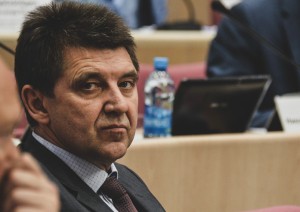
As the VChK-OGPU and Rucriminal.info discovered, the "entirely domestic drones" of Samara businessman Vyacheslav Maleev (a member of an organized crime group from the 1990s) turned out to be packed with Chinese electronics and run on open-source software.
Vyacheslav Maleev is a well-known figure in the Samara Region. He is the owner of the Avtokom holding company (a supplier to AvtoVAZ) and a former member of the local regional Duma. By the 2000s, Maleev's Avtokom managed the Kaluga Automotive Electronics Plant, the Lyskovo Electrotechnical Plant (Nizhny Novgorod Region), and the Kozelsk Mechanical Plant. He also owned a stake in the Kinelagroplast plant. In 2005, he also acquired the Serpukhov Automobile Plant from AvtoVAZ. Since 2023, several of his companies have been producing UAVs, initially marketed as civilian products for agricultural producers. However, it soon became known that Maleev is also eager to supply the military with his products—for example, he donates propellers to the Arkhangel project, and two of his companies, DeltaTech LLC and Avtokom LLC, are working on customizing drones for the Air Defense Forces. This was explicitly stated by Samara University, which has undertaken some of the contract development work. Furthermore, DeltaTech filed a declaration for electronic warfare systems back in 2024.
The website of Maleev's main drone company, MVM Avia, states that the company has established its own production of entirely domestically produced UAVs and can design and manufacture the necessary equipment—from frames to engines and propellers—to order and meet specific needs. Some of these products are manufactured by another Maleev company, KINELAGROPLAST, whose products are included in the Ministry of Industry and Trade's registry: four propeller models and a drone frame, the patent for which is registered to Vyacheslav Maleev and the director of MVM Avia and Kinelagroplast, Petr Kuzovenkov (under Ukrainian sanctions).
However, the "completely domestic" origin of the remaining equipment is highly questionable. For example, the PKF4 AT32F435 flight controller, claimed to be a proprietary development, has a main processor from the Chinese company Artery Technology, an inertial measurement unit (IMU) from the German company Bosch Sensortec, and all of this runs on the open international Betaflight firmware. The Electronic Speed Controller, a controller found in each of the four electric motors, is also Chinese and runs on international open source software.
Maleev and Co. have effectively established the production of drone hardware—frames, propellers, and other components—at their auto plants and related facilities, but all electronics and software are sourced from abroad. For example, the AT32F435 from Artery Technology and other dual-use Chinese products are offered by OOO TD PROMELEKTRONIKA (Yekaterinburg), RadioElement (St. Petersburg), GC Symmetron, and others.
In April 2026, two of Maleev's companies—Samara-based Deltatech and Kaluga-based Avtokom Motor—were placed under EU and Swiss sanctions. About a month earlier, Maleev had transferred the ownership of the Kaluga company to its director, Igor Skudarnov, and changed its name to Kreaprom (the company remains on the sanctions list under its previous name).
To develop the UAV, Maleev signed contracts with Samara University named after Academician Korolev on behalf of his companies, Avtokom and Deltatech. To give an idea of the scale, the university also has contracts with RCC Progress (part of Roscosmos), Beijing Xiangyu Space Technology Company, and Samara's Aviakor-Aviation Plant.
The joint work for Deltatech resulted in the development of several "fully domestic" UAV models, including the Kurier-1 and Kurier-2, which Maleev's company is currently manufacturing. However, as it turns out, Samara University didn't reinvent the wheel and simply added additional features (such as video equipment) to the Chinese 7-inch Chimera drone manufactured by iFlight. This Chinese company was mentioned several years ago in a Reuters investigation into UAV deliveries to Russia, with journalists calling iFlight Technology a subsidiary of DJI, the world's largest drone manufacturer.
To be continued


