


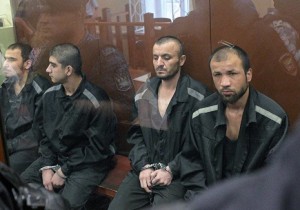
During the closing arguments in the Moscow City Court, the prosecutor requested that the perpetrators of the Crocus City Hall terrorist attack be sentenced to life imprisonment. The hearings are being held behind closed doors, which is not surprising, as numerous questions have arisen regarding the investigation, as raised by the Cheka-OGPU and Rucriminal.info after reviewing the case materials. They clearly reveal a series of shortcomings and errors by the regulatory authorities, which were exploited by the radicals, who trained militants from Afghanistan (Russia's new great friend).
The terrorists organized themselves into several cells, entered and exited the country without hindrance, having criminal records in both Russia and Tajikistan. The radicals moved freely between regions, retrieved weapons from caches and transported them from city to city, purchased components for IEDs, and conducted reconnaissance in camouflage clothing in crowded areas.
They were captured on CCTV cameras and by private photographers, by security personnel, border guards, and police officers, including traffic police.
All the terrorists were in Russia illegally, but the investigation brought no charges against the immigration services. Moreover, the case materials indicate that a large number of their fellow countrymen assisted the accused in preparing the terrorist attack: they provided them with SIM cards, transferred money, and even bought gasoline, which they later used to burn down the auditorium with people inside. However, the investigation, without any further investigation, admitted that they had all been used "in the dark" and did not prosecute their fellow countrymen. This stands in stark contrast to the Crimean Bridge bombing case. As a reminder, the defendants in the Crimean Bridge case included people involved in the transportation of the cargo, but it was proven that they did not and could not have known about the bomb inside the cargo. But with no other recourse, investigators charged them with terrorism, and the court later sentenced them to life in prison.
Witness accounts in the "Crocus case" provide a true picture of the first minutes of the terrorist attack and expose the lies of official agencies. Remember how the Russian Ministry of Internal Affairs and the FSB, criticized immediately after the attack, posted a video of their officers' "heroic act." They allegedly stormed the burning building, climbed through the smoke to the fourth floor, broke down the door to the server room, and reviewed all the recordings, which enabled them to quickly identify the car carrying the terrorists and apprehend them. This all turned out to be a complete lie. The testimony of a huge number of witnesses reveals the true picture of what happened. The heads of the Ministry of Internal Affairs, the FSB, and other intelligence agencies were in a panic and simply didn't know what to do. They didn't even know whether there were terrorists inside yet. As a result, Crocus's security chief, Yukhnovich, upon learning of the incident, drove from his home to the concert hall, approached the Ministry of Emergency Situations staff, and told them about the server room containing the recordings. Despite the enormous risk, Yukhnovich and the rescuers climbed through the flames and smoke to the third floor (which is where the server room was located, not the fourth floor), broke down the door, retrieved the digital media, and handed them over to the Ministry of Internal Affairs and FSB officers outside, who were afraid to enter. Thanks to the heroism of Yukhnovich and the rescuers, the car carrying the terrorists was identified, but their feat was simply stolen by the Ministry of Internal Affairs and FSB leadership.


