


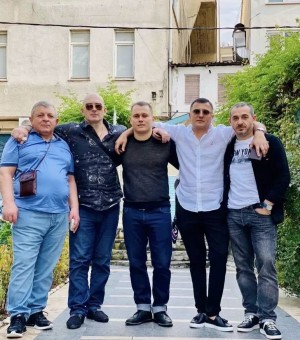
The much-hyped “first coronation of ‘thieves-in-law’ in 12 years” ended, as expected, in a fizzle. Within the criminal underworld, no one—aside from those who took part in the event in Italy—has recognized these newly minted “thieves-in-law” as such. Furthermore, the status of the gathering’s primary organizer, Tariel Oniani (“Taro”), has long been in question—a matter he has been unable to resolve. Consequently, this was more of a “publicity stunt” than a true “coronation.”
The clan of Tariel Oniani and Merab Jangveladze, once quite large, has significantly dwindled and weakened in recent years. According to estimates from a source for VChK-OGPU and Rucriminal.info, the group currently consists of no more than 15–20 "mafiosi." It is significantly smaller than the clan led by Taro’s primary opponent, Lasha Shushanashvili—the very man who, with the backing of "Thief-in-Law No. 1" Zakhar Kalashov ("Shakro"), succeeded in having Oniani’s status as a "thief-in-law" suspended. Neither Taro nor Merab has a habit of providing financial support to members of their clan, and there is currently no other incentive for anyone to join them. Consequently, the only way to bolster their ranks is by holding their own "coronations"—effectively "stamping out" new, loyal "thieves-in-law." The primary obstacles to this—aside from the moratorium on coronations declared by Shakro—were the suspension of Taro’s own status, which had been initiated by Lasha. These events are interconnected. For years, Oniani has sought to resolve the issue. He proposed holding a large-scale *skhodka* (a gathering of underworld leaders) to declare a "general reconciliation"—a process where all conflicting "thieves-in-law" forgive one another without the need for apologies or further confrontation.
However, this format was unacceptable to Lasha. According to the source, Lasha insisted that, prior to any "general reconciliation," there must be another *skhodka*—essentially a "trial" of Oniani and the members of his clan. Shushanashvili’s position is that, at this gathering, Taro must prove he had no involvement in the murders of Aslan Usoyan ("Ded Khasan"—once considered "Thief-in-Law No. 1") and Vyacheslav Ivankov ("Yaponchik"). Taro, for his part, maintains that he was serving a prison sentence at the time of these crimes and therefore could not have had any connection to them. Furthermore, Lasha demanded that Taro and Merab ensure the attendance at this *skhodka* of "thieves-in-law" from... ...members of their clan who are known beyond any doubt to have the blood of other "thieves-in-law" on their hands. This group includes Ilya Simonia ("Makho"), Roin Uglava ("Matevich"), Irakli Kalichava ("Khutu"), Zurab Dgebuadze, and others. The first of these makes no secret of his role in the murder of "Yaponchik," while the others have personally attacked fellow "thieves-in-law" with knives. Lasha’s position is that this group of mobsters must "remain at the gathering" forever—meaning they are effectively condemned to remain in a state of perpetual, unresolved conflict.
Naturally, Taro could not accept these terms, nor could he find a way to resolve the issue. Furthermore, Zakhar Kalashov—albeit discreetly—sided with Shushanashvili. A "general reconciliation" (a *obshchiy raskhod*) would not have been in Kalashov’s interest, as it would have allowed Taro and Merab to begin "churning out" new, loyal "thieves-in-law," thereby expanding their own clan.
Tired of waiting for a "general reconciliation," Merab and Oniani decided to hold a gathering without it. However, there was no appetite for such an event—neither among established "thieves-in-law" nor among the "aspirants." For the former, it risked an inevitable confrontation with the criminal underworld’s leadership and Lasha himself. Moreover, a previous attempt by Merab and Taro to hold a gathering in Bulgaria had ended disastrously: Bulgarian intelligence services discovered the list of attendees, leading to arrests at the border. Seven or eight of the mobsters were found to be carrying forged European documents and ended up in jail.
For the aspirants, participating would have meant forfeiting any chance of ever becoming a legitimate "thief-in-law"—as opposed to one recognized only by Merab and Taro. Ultimately, according to the source, seven Georgians were "crowned." ...mid-level gangsters.
As expected, the headquarters—and its leader, Shakro—did not recognize these newly minted "thieves-in-law," nor did Lasha and the members of his clan.


