


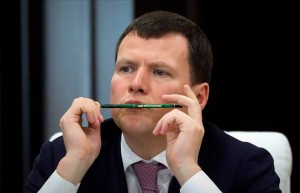
As VChK-OGPU and Rucriminal.info have learned, RUSNANO and its head, Sergey Kulikov, paid over 20 million rubles to State Duma Deputy Pyotr Tolstoy (until recently a Deputy Speaker of the Duma) for lobbying on their behalf at the international level. The funds were funneled through a shell company that the state corporation uses for such purposes. When the FSB took an interest in the matter, RUSNANO scrambled to recover the diverted funds from the shell company in a bid to cover its tracks.
Case No. A40-126952/2026 is gaining momentum in the arbitration court records. The plaintiffs are JSC RUSNANO and LLC Rosnanotechinvest. The defendant is a modest Moscow-based firm, LLC Sky Gallery. The claim amount is 22,910,140 rubles. For RUSNANO—which is suing its former management for billions—this is a drop in the bucket. But the devil, as always, is in the details.
The company was registered on December 16, 2010. Its primary business activities are software development and advertising services. Its General Director and sole founder is Rauf Rayasat Ogly Aliyev.
In 2022, the new head of RUSNANO, Sergey Kulikov, personally appealed to the Prosecutor General's Office to investigate the activities of his predecessors, led by Anatoly Chubais. This resulted in criminal cases involving the embezzlement of tens of billions of rubles. Kulikov publicly cast himself in the role of a "corruption fighter." However, it was precisely under Kulikov’s tenure that Rusnano and its subsidiary, Rusnanotechinvest, signed a €23 million contract with Sky Gallery. When the situation heated up, Kulikov himself filed a lawsuit to recover the funds. It looks like a staged attempt to show action: "We uncovered the violation ourselves and went to court—look how good we are." In reality, it was a classic case of covering one’s own back.
Pyotr Olegovich Tolstoy is a Deputy Speaker of the State Duma, a descendant of Leo Tolstoy, and a former Channel One TV presenter. He was elected to the Duma in 2016 and has been re-elected multiple times since. According to sources from VChK-OGPU and Rucriminal.info, Rusnano and Kulikov enlisted Tolstoy specifically to "sort out" problems arising from international sanctions. Rusnano’s subsidiary, Rusnanomedinvest, owned the Luxembourg-based company RMI, which had funds frozen in an account at GPB Bank. The assets were frozen because Kulikov was listed as the company's beneficiary; the sum involved was nearly €19 million. Rusnano spent all of 2025 unsuccessfully trying to unblock the money. They sought foreign assistance—specifically, law firms. Tolstoy volunteered to find such helpers and succeeded. The "gratitude" payment was transferred via a sham contract with Sky Gallery. There is testimony indicating that, in reality, the funds were controlled by Kulikov’s deputies, M.N. Marichev and V.D. Yunusov, while the ultimate recipient was Tolstoy.
When the FSB confronted Kulikov about this matter, he backpedaled, initiating a lawsuit to formally distance himself from the scheme. However, the lawsuit was filed not against Tolstoy, but against a technical shell company. Incidentally, this is likely why there may have been an attempt to seal the case records—to avoid drawing attention to the deputy speaker's name.
Rusnanomedinvest LLC is a wholly-owned subsidiary of Rusnano, established for venture capital investments in biotech. Rusnanotechinvest LLC (the plaintiff in the case) is another entity within the state corporation, focused on holding company activities. Both are essentially captive entities of Rusnano; funds flow between them without oversight. The lawsuit was filed jointly by both legal entities—possibly to obscure the trail.
Meanwhile, the state corporation’s financial reports continue to raise questions. In 2025, JSC Rusnano’s revenue (under Russian Accounting Standards) plummeted nearly fourfold, falling from 8.38 billion rubles the previous year to 2.16 billion rubles. Yet, net profit surged 2.4-fold to 4.96 billion rubles. In the first quarter of 2026, revenue dropped another 25% to 245.3 million rubles, while net profit tripled to 94.3 million rubles. The company attributes this to "specific corporate events"—a euphemism for asset revaluations and one-off transactions.
In the first half of 2025, revenue stood at 1.6 billion rubles—a 3.8-fold decline. At the same time, profit from sales rose 2.4-fold to 811 million rubles, and gross profit increased by 38.6%. Between January and September 2025, revenue fell 4.3-fold to 1.87 billion rubles. In the first quarter of 2025 alone, revenue plummeted 17.3-fold to 327.9 million rubles. The company explained that this trend was "driven by the completion of its exit from assets."
The paradox is obvious: revenue is dropping sharply, yet profit is rising. In 2024, revenue had grown 3.5-fold solely due to asset sell-offs—proceeds from project exits totaled 8.9 billion rubles. By 2025, there was nothing left to sell. Between 2021 and 2023, Rusnano generated 74 billion rubles from asset sales. Investments in startups for 2025 amounted to 2.3 billion rubles. For comparison, debt repayment alone consumed many times that amount.
No dividends are being paid for 2025, despite the reported profit. The existence of profit alongside an inability to pay out dividends is the clearest indicator that the profit is merely "on paper." The state has already allocated over 43 billion rubles between 2022 and 2024—not for development, but to avert default on guaranteed loans. The outstanding debt at the end of 2025 stands at 11.127 billion rubles, and the company openly expects its shareholder to settle it.
This is a classic scheme: manipulating financial statements to create an illusion of stability while siphoning off budget funds through consulting contracts with shell companies. The sum of 23 million rubles is modest, yet sufficient to "reward" a key individual. Rosnano continues to churn out questionable contracts, while its financial reports keep displaying paradoxes that defy logical explanation.
The hearing for Case No. A40-126952/2026 took place on October 1, 2026, at 12:30 PM. The parties had exchanged motions the day before. A preliminary hearing originally scheduled for mid-August had been postponed by a ruling from Judge Volozhbenskaya. The proceedings were held behind closed doors, with access to the case files restricted. The operative part of the court’s decision has not yet been released. We will certainly revisit this case and report on the outcome once the decision becomes available.


