


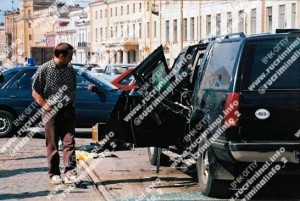
According to the VChK-OGPU and Rucriminal.info, Ilya Traber (Antikvar) may be charged with other high-profile murders (he was arrested for the assassination of Vyborg boss Alexander Petrov). These include the execution of the family of a prominent Chechen businessman, the murders of Pavel Kapysh, CEO of the Baltic Financial and Industrial Group, and Mikhail Manevich, Vice Governor of St. Petersburg. Traber may have organized the latter two crimes in collaboration with Vladimir Barsukov (Kumarin). Materials on these incidents have already been requested, and work is underway. However, the murders of Kapysh and Manevich, in one way or another, affect all current high-ranking officials who hail from St. Petersburg. Therefore, even if "iron-clad evidence" of Traber's involvement is gathered, the decision will be made at the very top. So far, according to our project, no restrictions have been issued to members of the investigative task force on these topics; interrogations and other activities are underway. High-profile arrests are also possible. For example, those of the perpetrators in the Kapysh case. Of the five, at least three are still alive. However, the armored Chevrolet in which the perpetrators trained before the attack is no longer to be found. It was scrapped.
Mikhail Manevich (all investigative documents about his murder and the early years of the investigation can be found on the website Rucriminal.info by searching for "Manevich") was a close friend of Anatoly Chubais, German Gref, and many other prominent Russian figures.
In 2011, we conducted a major investigation into the circumstances of Manevich's murder, and all the threads leading to the crime led to the struggle for the St. Petersburg Seaport, which in the 1990s was being actively seized by the shadowy businessman Ilya Traber (the antique dealer was close to Kumarin at the time).
As sources noted, Manevich and Traber were family friends and were in constant contact. Whenever Manevich's decisions could affect the interests of dangerous people, leaders of organized crime groups, Traber immediately intervened, shielding his friend from possible consequences. Their falling out arose over the fate of the St. Petersburg Seaport. After Manevich's death, it was also revealed that Traber had been courting his wife Marina, making advances toward her.
In 1997, Manevich was expected to be promoted – Chubais offered him the position of Deputy Chairman of the State Property Committee. Before moving to Moscow, the head of the State Property Committee (KUGI) decided to finalize all his affairs in his hometown, including finally fulfilling Chubais's order to transfer 28.8% of the port's shares to ordinary status. Traber dissuaded his friend from such a move, citing the risk of "crossing the path" of a host of dangerous people. Sources at the time reported that Manevich apologized but insisted on the need to make such a decision. He was killed by a sniper before he could carry it out.
On July 26, 1999, Pavel Kapysh, CEO of the Baltic Financial and Industrial Group (BFIG), was assassinated in St. Petersburg. He was riding in an armored Chevrolet, surrounded by cars carrying bodyguards. When the motorcade stopped at a traffic light near the Lieutenant Schmidt Bridge, masked assailants opened fire with grenade launchers. They knew the armored Chevrolet's weak points and managed to achieve the desired result.
For Russian law enforcement, the identity of the "customer" was an open secret almost from the very beginning. In 2009, the Russian Prosecutor General's Office submitted a report to Spain that clearly stated: "During its formation in 1991-93, the Baltic Financial and Industrial Group (BFIG) maintained relations with the Tambov organized crime group (OCG). The OCG exercised control over the company's activities and provided cover for illegal transactions involving oil and petroleum products." Beginning in 1999, Kapysh began pursuing an independent policy, entering into open conflict with Ilya Traber, an economist from the Tambov organized crime group…”
This is somewhat crudely stated, but true. In 1999, Kapysh decided to break with Traber and Kumarin, who were responsible for all petroleum product transportation. He organized the purchase of shares in OAO Sea Port of Saint Petersburg. Kapysh also wanted to build his own terminal, bypassing Traber, and actively lobbied for this with the Russian Ministry of Transport and the Saint Petersburg Administration. He had no fewer connections than Antikvar.
However, until 2026, Traber remained an untouchable figure. Now everything has changed. And Kumarin isn't the only one to be blamed for the old high-profile murders.


