


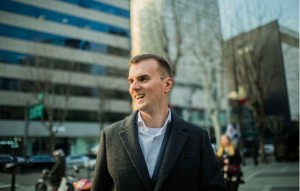
The US continues to unravel the case of Yuri Gugnin, the Russian creator of the Evita crypto platform, who was arrested last summer. In April, Gugnin (aka Yuri Mashukov, aka George Gugnin) pleaded guilty to money laundering through his crypto companies Evita Investments and Evita Pay, evading US sanctions, illegally operating as a payment processor, fraud, and other crimes. As a result, he cooperated, and less than a month and a half later, his business partner, "Sergey BTR," was arrested in Cyprus. Apparently, he will also soon appear in American court. This is certainly not the last arrest in the "Evita scheme": Gugnin had dozens, if not hundreds, of partners in Russia and abroad. Among them were representatives of the GRU and the FSB, an advisor to Chemezov, and others.
Yuri Gugnin is a graduate of the Moscow State Technical University. Bauman Moscow State University. In the 2000s, he headed web development at ADV, then served as managing partner at the RIK Business School and the consulting firm Komanda-A. He owned several companies in Russia, including firms under the Karma brand, in which his business partner was Muscovite Sergey Bochkov. It is also known that another long-standing business partner of Gugnin was Artem Laptev, a former Troika Dialog employee. The Karma platform, which they launched together in Russia, issued P2P loans and even held a Central Bank license. However, market participants openly called it a Ponzi scheme and predicted trouble for investors. The project quietly languished for several years until it was transferred to another owner – in 2024, it was relaunched under the name Investin.vc (OOO Invest In). However, Gugnin retained control of Karma's Estonian legal entity, KARMA PEOPLE OÜ.
Gugnin permanently moved to the United States in 2022. Prior to this, he advertised on social media for talented programmers for his new project and announced that he had secured an investor: "We raised a round from a pleasant VC fund with a friendly, family-like atmosphere of mutual support. It's more of a venture builder/studio than just money." According to US registries, Gugnin is the sole founder of Evita Investments and Evita Pay, but the latter's president is a certain Theodore Darenkov—apparently a Muscovite named Fedor Darenkov, an American of Russian descent who moved to the US while still in school.
In just a couple of years, Gugnin transformed the American cryptocurrency company into a secret financial conduit and transferred over $530 million through the US financial system (and organized transactions totaling $2 billion), helping sanctioned Russian banks process payments. His business spanned China, South Korea, India, Hong Kong, Singapore, the UAE, and other countries. Gugnin received funds in USDT, then withdrew them and exchanged them for fiat dollars, deposited them into his company's New York bank accounts, and then paid for goods and services required by Russian clients. Initially, he used the Russian cryptocurrency exchange Garantex, but it was later sanctioned, forcing Gugnin to find a replacement.
American investigators were very grateful to the meticulous Russian, who carefully saved his contacts in his iCloud account. For example, it contained information on GRU and FSB officers (including a scheme proposed by one of the FSB officers to launder money through China), as well as information on aides to a State Duma deputy, an adviser to Sergei Chemezov (Rostec), and a representative of the Iranian government. Furthermore, Gugnin recorded his financial income and expenses in a separate document. For example, the address and email address of a wealthy Muscovite for whom Gugnin purchased $43,500 worth of art at an American auction remained there. For another Russian citizen registered in Stavropol, he transferred €150,000 to France for yacht maintenance.
The items purchased included Western technologies, the import of which is prohibited in Russia, as well as luxury goods: optics, electronics, smartwatches, paintings from auctions, dental equipment and implants, a server for a Russian developer of AI solutions, and so on. Some of the technology was reportedly destined for Rosatom's engineering divisions.
Furthermore, Gugnin managed to open a company in the UK, six months before his arrest. Initially called EVITA INVESTMENTS INC LTD, the firm was renamed ONE EVE INC LTD in March 2025. For obvious reasons, Gugnin was unable to submit the necessary documents to British officials this year, so his company is now facing a fine and the threat of forced liquidation.
The cryptocurrency platform BlockFills, which Yuri Gugnin's American companies used, is also under attack. The platform's owner, Delaware-based Reliz Technology Group Holdings Inc., is currently undergoing bankruptcy proceedings, so Gugnin will likely be unable to recover the funds held by BlockFills. However, the platform's management will have to negotiate with American law enforcement. The prospect of a similar conversation hangs over Gugnin's other counterparties.
For example, the Dubai-based travel agency TRVL, which organizes luxury cruises for the elite, and France's Ponant Explorations (owned by François Pinault, the master of Gucci and Saint Laurent). Both were involved in a scandal last year involving the cancellation of a North Pole tour for 150 extremely wealthy Russians, including an audition for the band Leningrad (a seat cost between $70,000 and $200,000). Among the ship's passengers were top executives from Yandex and Russian oil companies, restaurateurs, and a reality TV host with 20 million subscribers.
TRVL's founders are Russians Boris and Evgeny Pustovoitov, who also own the Dubai-based car tuning company DEIZ. As it turned out, their Russian legal entity, Vot Eto Da LLC (NEVEREND brand), transferred funds to Ponant through Gugnin's company for the lease of the icebreaker Le Commandant Charcot to Ponant. The Frenchman, characteristically, had no issues with the Russians. Gugnin cancelled the deal due to Gugnin's arrest, but refused to return $5.8 million of the total $8.5 million. So, the Pustovoitovs are pursuing legal action to recover the money and demand $8.1 million in damages.
Gugnin had dozens, if not hundreds, of counterparties, and not only in Russia. By agreeing to a plea bargain with investigators, he automatically indicated his willingness to name them. Any travel outside the Russian Federation or friendly jurisdictions could be fatal for these individuals—Gugnin himself, for example, faced up to 30 years in prison. By admitting guilt and cooperating, he could reduce his sentence to 10 years.


