


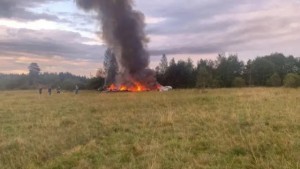
The Cheka-OGPU and Rucriminal.info have uncovered details of how the Investigative Committee of Russia quietly closed the case into the crash of the plane carrying the leaders of the Wagner PMC, Yevgeny Prigozhin and Dmitry Utkin. The relatives of absolutely everyone on board were officially recognized as victims, meaning that legally, those on the plane were not at fault. And there was simply no investigation into who was at fault. The case was closed shortly after Putin's statement about a "grenade" and "cocaine."
Nezygar and Yezh were the first to notice that the Moscow City Court and Supreme Court websites contained records of complaints filed by Pavel Prigozhin (Yevgeny Prigozhin's son). The documents indicated that Pavel had attempted to obtain a court order to dismiss the criminal case into the plane crash. Moreover, it turned out that the decision was made back in December 2023. Our project discovered how this happened.
The case was opened on August 23, 2023 (the day of the crash) under Part 3 of Article 263 of the Russian Criminal Code (Violation of Safety Regulations). The investigation was conducted with special considerations.
Both the voice and flight recorders were immediately seized by the FSB after their discovery. Experts were told that investigations are conducted even in cases where the flight recorders are damaged, so it was previously stated that their conclusions would have to rely on data from other sources. This does not include the flight recorders.
The special commission investigating the emergency near the village of Kuzhenkino (see the video for footage taken immediately after the crash) was headed by Rosaviatsiya employee Valery Luchinin, who is known for his ability to bend results to suit the version of events presented by higher authorities. Back in 2014, he was part of the team investigating the downed Malaysia Airlines Boeing.
However, this time, no theories were initially handed down from above. Therefore, the commission simply carried out its work. According to experts, what was captured on eyewitness footage and even what random villagers observed had no connection to the accident. The distance from the initial point (where small debris was discovered) to the impact site of the first large section—the vertical stabilizer (tail assembly)—is 3.5 kilometers.
Experts concluded that a minor explosion initially occurred on board, the aircraft flew for some time, gradually disintegrating, and the collapse of the vertical stabilizer and then the wing was a consequence of the overloads the jet was subjected to after the initial damage.
The distance from where the vertical stabilizer fell to where the wing was discovered is 400 meters. From this point to the crash site of the entire aircraft is another 2 kilometers. It turns out that the plane's total flight distance, disintegrating in mid-air, was 6 kilometers from the point where the explosion occurred to the point where the plane crashed.
It was established that the pilots were in their seats and their bodies were unharmed by the explosion. It's highly likely that the pilots were conscious after the explosion and attempted to save the plane. However, due to the damage, it began to disintegrate, eventually leading to its crash. Incidentally, no recordings of the crew's communications with air traffic controllers after the explosion are in the case file.
According to Rosaviatsiya, no shrapnel (such as from a grenade) was found in the surviving fuselage. Incidentally, no grenade fragments were found in the bodies of the victims either.
The conclusions were clear. A low-power bomb had been planted on board, which detonated, and this was enough to trigger the plane's disintegration. The almost exact location of the "infernal machine" was even determined. We'll tell you in the coming days who could have planted it and how.
However, the Investigative Committee categorically refused to accept any of the commission's data or documents, even preliminary ones. Everyone was waiting for a "version from above." To stall for time, the Investigative Committee ordered an incredibly lengthy and complex forensic examination—to reassemble the entire plane from the recovered parts. Under this pretext, all the wreckage was transported approximately 30 kilometers from the crash site along the M10 highway to the closed military settlement of Ozerny. However, no one intended to carry out the forensic examination. The wreckage was simply dumped in an abandoned hangar, and it wasn't even sealed.
The "version from above" arrived in early October 2023, and it exceeded all expectations. Then, at a meeting of the Valdai Club, Vladimir Putin, citing Bastrykin, stated that "fragments of hand grenades were found in the bodies of those killed in the plane crash," and that "there was no external impact on the plane; this is already an established fact." Putin also expressed regret that no tests had been conducted to detect traces of alcohol and narcotics in the blood of the deceased, and recalled that 5 kg of cocaine had been found during a search of Prigozhin's office.
Of course, such tests had already been conducted at the time of Putin's speech and had already been added to the case file. No traces of drugs or alcohol were found in the deceased.
The Investigative Committee, however, found itself in a difficult position. Should all the tests be tailored to Putin's version of events? Of course, they have experience. But the case is still complex and, sooner or later, will inevitably lead to publicity and heated debate about the veracity of the investigation's findings.
Furthermore, by that time, the relatives of the deceased had already The victims were already at their breaking point. For example, the crew members' families were unable to receive insurance payments. In their denials, the SOGAZ insurance company cited the following conditions: to receive money, the insured person must be recognized as a victim by the investigation. Furthermore, payment could be denied in the event of a terrorist attack.
Fostering the cocaine and grants narrative threatened to provoke the victims' relatives to launch a legal battle and publicize everything they knew about the case.
So, a clever ploy was devised to keep only the grenade and cocaine narrative in the public domain and avoid any discussion.
On November 1, 2023, absolutely all relatives of the victims, including those of Yevgeny Prigozhin and Dmitry Utkin, were issued orders recognizing both the victims and themselves as victims in the plane crash case. This meant that legally, everyone on board was declared innocent. SOGAZ will immediately pay the crew members' relatives what they are owed, which in turn can be interpreted as a refusal to recognize the plane crash as an act of terrorism.
The Investigative Committee of Russia apparently assumed that the relatives would remain silent now that they had gotten what they wanted. A little over a month later, the case was closed. It's difficult to say what expert analysis was used. It's possible they reached the same conclusions that were later used to close the Azerbaijan Airlines crash case. At that time, it was stated that the damage to the aircraft, according to the commission's findings, could have been caused by submunitions from the warhead. However, as the document notes, it was impossible to determine their origin. Here too, they could have indicated that an explosion could have been the cause, but the cause is impossible to determine.
However, none of the relatives of the victims were informed that such a ruling had been made. It was decided to keep everything completely confidential. However, Pavel Prigozhin somehow learned of it and, now a victim, attempted to obtain the document so he could appeal it. But to no avail.


